Ode to the Fountain Pen
I have a soft spot for analog things. I recent years I've grown fonder and fonder of fountain pens for long form handwriting. Despite my somewhat messy writing, the fountain pen has a tactile feeling to it that I just find pleasing and comforting. It's forcing me to disconnect and think.
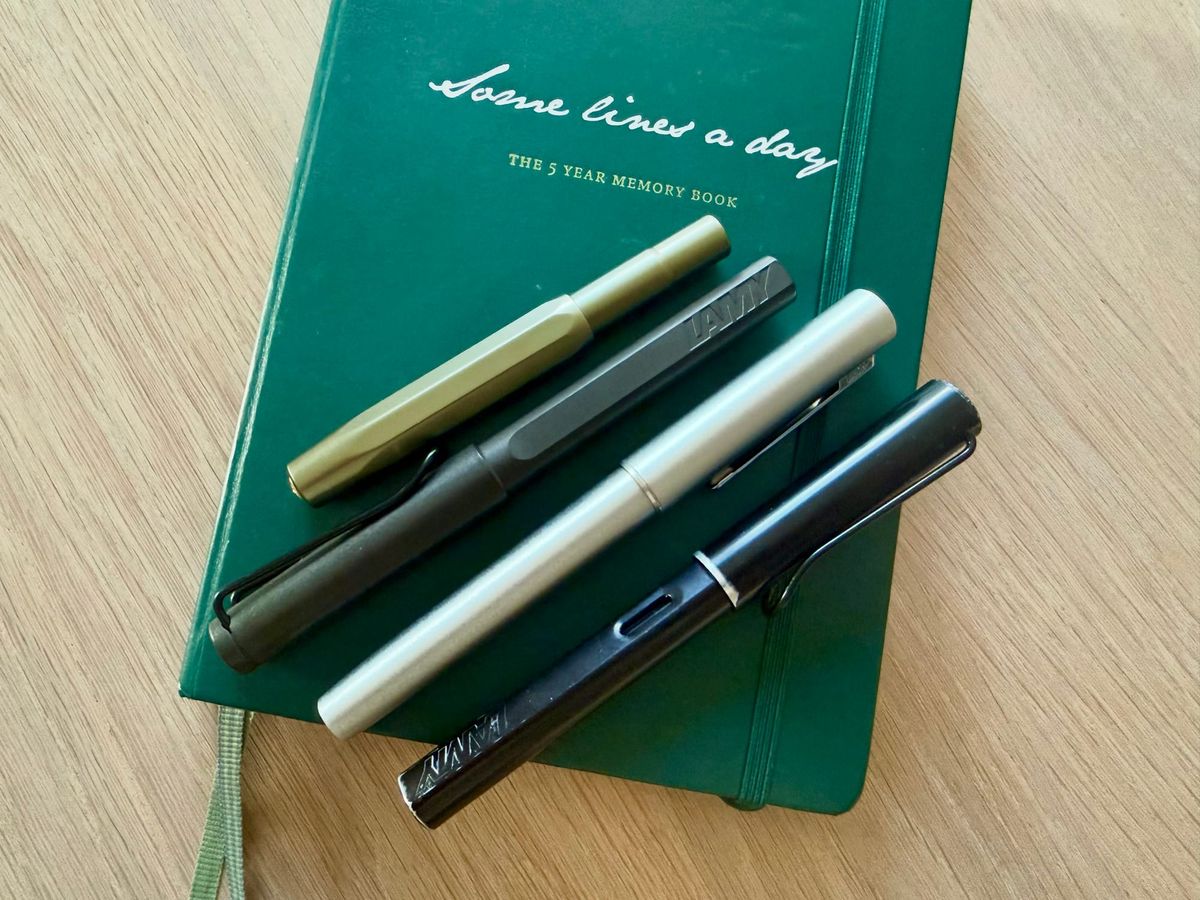
I like pens. Just before typing this, I wrote with one in a paper notebook, my daily journal. With a fountain pen, to be exact, the most unusual of pens, at least based on people's reactions when I use mine.
Every now and then I'm in a situation where I pull out my little pen pouch and a notebook and then dump a whole handful of different pens on the table in front of me. Hilarity ensues when people are around. Some can't believe their eyes, wondering why anyone would still bother using one. Others are taken back to their school days, probably the last time they ever wrote with one. I get a lot of questions and disbelief when this happens.
I get it. It's so easy to take notes on your phone or on your computer, where they'll be stored for posterity and can be pulled up whenever they're needed. A paper notebook, let alone multiple, each serving a different purpose? Why yes, I have several in active use at any given time. Chances are slim that you'll have all of them on you at all times. Your phone is always on you. So why bother?
I sometimes feel or fear that enjoying pens and insisting on writing on paper is a longing of simpler times, a throwback to when times were, so it might be believed, better. But I don't think that's it. I've spent most of my life typing things on a keyboard, just like this piece or, for years prior to just writing words as posts, memos, or documents for my clients and teams, mountains of code. It’s something else.
I have been thinking about small things lately, meaning things that may represent something that seems long gone, but that also still offer an alternative to how things are today. Writing has gotten so easy to the point where you don't have to write anymore. You can just prompt an AI to write something for you, hoping it'll approximately match your style and also gets the message across.
Writing with a pen almost feels like an act of resistance to that. It offers an alternative to the digitalism and algorithms that are now ubiquitous. It offers a level of connection they don't offer. It’s not like I reject the digital pieces entirely. It’s more that I like to remind myself regularly that they’re not inevitable, that there are other ways. Slower, yes, but that slowness serves a point.
When I write with a fountain pen, of which I have four different ones at this point, each has their own character. Each writes slightly differently, requires more or less effort and brings more or less ink onto the page. Each scratches differently, which also depends on the paper you write on (I like Leuchtturm notebooks, in case you were wondering). Each has a different point where the ink slowly starts to fade as you write. Give it a little shake (with cap on) and you’re back in the writing business.
The funnest part about fountain pens is that they have, in their most basic form, no mechanical parts. It's all physics that makes the ink flow from cartridge to the tip of the nib and onto the paper, without ever spilling or leaking. Fountain pens for me offer a tactile connection to the paper. You can feel and hear the slight variations in paper quality and also on each individual page. It’s a connection a digital pen couldn’t replace. The only time I use something mechanical is when I refill the pens, turning a little dial that creates pressure in the little refillable cartridge so that ink flows, through the nib and pen construction, up into the cartridge.
And I'm writing all of this ready to admit that I don't have great handwriting. Which many folks who've been receiving postcards from me this year (another story) can probably attest to. Sometimes I do struggle to decipher my own handwriting. Which does pose an extra challenge when you quickly scribble down important tasks or useful ideas. It's also a challenge to most handwriting detection. It's not as bad as a doctor's handwriting, I can assure you. But it can be challenging to read when I write too fast and with too little care.
The clear alternative could be to just write an e-ink-based writing device or use my iPad. Even though the handwriting detection on the devices I've tried just doesn't feel capable of dealing with my scrawl. It would certainly be easier to keep a digital record this way.
But then again, the digital aspect isn't the point. It's more about removing my brain from the screens around me, an act not just of resistance but also an act that fosters a different level of thinking. I take handwritten notes on calls instead of relying only on transcriptions. I always carry a small notebook with me for those impromptu ideas and thoughts that tend to come up when you're out on walks and the mind starts wandering.
There's something about the physical act of putting pen to paper that forces me to slow down. It's a deliberate act to escape the screen and the madness, messiness, and distraction it offers. It's an invitation to think, to pause a conversation to really make sure you're understood what was being said. When I sit down to write in my journal most mornings I take a pause and ponder what's been important to me since my last entry.
It might feel slow to the point of slowing you down, but maybe that's a good thing. We can certainly use more of that in a time when multiple agents and other content algorithms are feeding off our attention for so much of the day.
Part of me wouldn’t mind writing posts like these using pen and paper (Barack Obama wrote the first draft of his autobiography that way, the mind boggles). But when I get into the flow of writing to publish, a mechanical keyboard does a better job of keeping up with my desire to get thoughts written out before they vanish.
I wouldn't consider myself a collector, just an aficionado. I own no expensive fountain pens, i.e. more than 100 EUR, but for some of them, others might wonder why I bother spending the money. It's probably more akin to seeking to find the right pen for the right situation. I recently bought one from German maker Kaweco, made of aluminium, small enough to just slip into your pocket or slide into a pen loop and take with you. And it’s incredibly pleasant to write with. The aluminium casing makes for a good weight in my hand. I like pens with some heft. I also own three different types of Lamy fountain pens. What I do love about fountain pens is that you don't need to spend a fortune. Even Lamy's cheapest Safari models offer a great writing experience.
And it's not just fountain pens either. I would say it all started with Baron Fig's pens that I got as a gift back in 2018. They showed me a writing experience, even for a rollerball (which I usually don't like writing with) that seemed magical. Maybe I shouldn't be surprised, as the underlying ink and refills are made in Germany. Ironic that they're pretty difficult to get here. Baron Fig's Squire pens have a heft to them that just increases that tactile feeling when you write. I now own four of them. As you do.
My appreciation for fountain pens feels more like it’s about something tactile and distinctly analog. You could argue that involves some sort of longing for simpler times or times long gone. To me it is about staying connected to something that feels uniquely disconnected.
As a CEO, I used to be out of office every Friday and spent the day thinking and writing, always carrying pen and paper with me. It was only when I was disconnected that I could ponder bigger questions and challenges about my business and the people in it. It allowed me to step back and reflect on how I showed up, what I did or didn't do well.
Maybe that's what pen and paper truly provide: a forcing function to disconnect from the distractions whose volume and loudness only seem to be increasing. A fountain pen, in this scenario, provides the added bonus of writing with something that is incredibly tactile in its use and ingenious in its construction.
Maybe a future project will be to spend time learning calligraphy, a focused effort to improve my handwriting. I would certainly like that.